
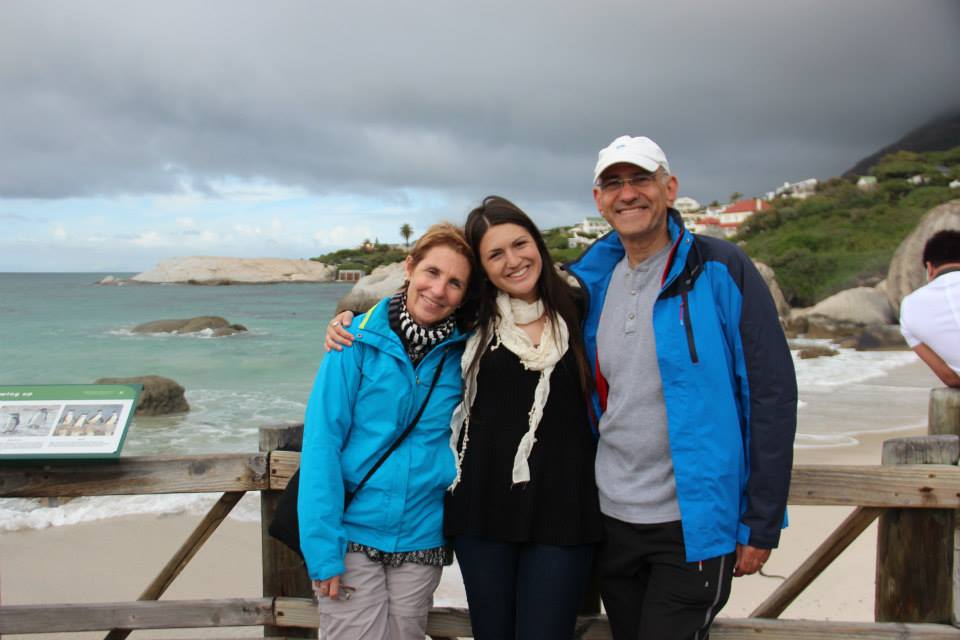
We´d made the decision to stay in a variety of different accommodations throughout our trip and that has been a real gem of an experience. In Cape Town itself, we first stayed in a rental apartment that overlooked the waterfront…centrally located, secure, and close enough to the beach promenade to run along the water. An added delight was having the pleasure to visit with a local family living in one of the more upscale outskirt sections of the city – in a gated and guarded planned community of spacious homes. We were treated to local braai (lamb barbeque) and interesting conversation about South African politics and evolution.
After adventures in eating at some weekly community food fests (You need to come to Cape Town hungry and ready to gain 10 pounds because the variety of cuisines is immense and scrumptious – eating as sport and social focal point), we visited the Cape of Good Hope, passed time with penguins, went wine tasting, and got to know some of Ruthie’s wonderful interning buddies. We then left Ruthie to finish out her last few days of work for the NGO, Green Pop. We headed along the Garden Route that skirts the eastern coastline of South Africa – touted as a must-do for touring in this scenic country. It is as advertised. One catch – there are not gardens all along this route (there are a few in some of the towns, but that’s not the dominant feature). Rather, this coastline is a continuous set of ever-changing landscapes – each one more breathtaking than the next.
We spent our first few Garden Route nights in the wine region at the Bovlei Valley Retreat – a serene guest house on the grounds of a winery. The British couple that owns the property takes great care to feed and water guests well (I was in heaven as our room was filled with fresh lavender from the gardens – soothes me like nothing else in the world), and we had the chance to get their perspective and the perspective of a young woman working there who is from Zimbabwe about the state of South Africa’s evolving society (more on that later).
The next stop was in a small town called Hermanus – famous for the whales that migrate close to the shoreline at this time of year. We stayed in a mother-in-law type guestroom in the backyard of Janice and Mark – a local couple who had listed with airbnb. Mark is a veterinarian and Janice has a pool maintenance business. Directing us to the local eatery for dinner we had a great, downhome meal chatting with folks a Rossi’s – Melanie, our server, doesn’t have to work but loves people! Hermanus is a quaint seaside town with a lovely walking path that runs along the beach that we took advantage of, of course. We didn’t actually get to see whales here, but they appeared in Mossel Bay later in our trip.
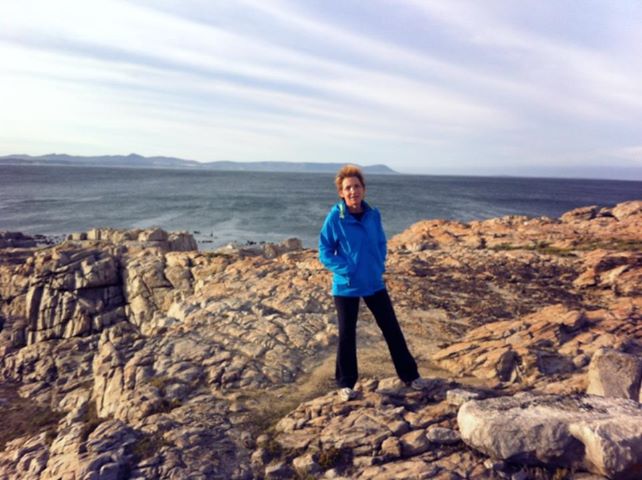
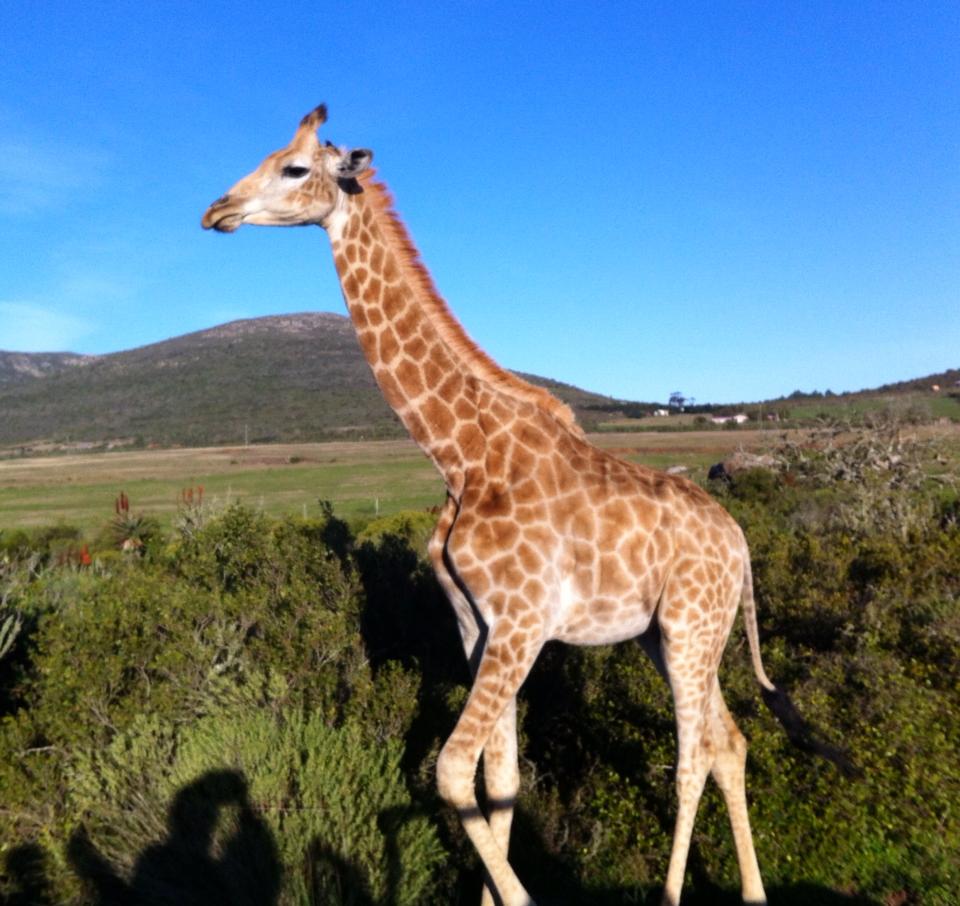
And then there was the Garden Route Game Lodge. Locals in Cape Town were a bit skeptical when we mentioned staying there – either they hadn’t heard of it or slapped a “for tourists” label on it. Truth be known, it is for tourists, but the rustic, African hut styled chalet we stayed in was cozy with an amazing view of the sunsets and animals grazing on the hilltops, the food was plentiful and fresh (we could have had grilled local kudu or venison if we wanted), and the safari drives we did at sunrise and sunset were a wonderful introduction to the wildlife in Africa. The reserve is massive, and although the animals are in fenced compounds, it is nothing like a zoo…it’s a nature park with strategically placed and well cared for animals living where you can actually see them. We had close encounters with lions, giraffes, elephants, kudu, cheetahs, rhinos, hippos, ostriches, and a few species I am probably forgetting. No doubt a safari in Kruger would be more in the wild, but you need lots more time and patience with no guarantee of seeing the range of animals that way. That for another time. Here we again met people from many places and gathered more perspectives on the state of (or perceived state) of South Africa.
We took a quick drive into nearby Mossel Bay to run and try to catch view of whales – and luckily we got to do both. We jogged along a nice path running atop the rocky cliffs, and stopped to chat with a local guy fishing. As we exchanged stories and asked him about whales he said “Right there!” pointing out to just beyond some breaking waves. Sure enough we saw a spurt of water, a big fin and we think perhaps a huge head surface here and there for many minutes. Apparently the day before there had been many whales passing through this very bay and this lone one had stuck around a bit longer. The fisherman had been watching him in the same general area all morning so our timing was great. Too far out to get clear pictures, but it was a treat we’d hoped for.
OK – that is the travelogue so far…now for some sobering reflections.
It’s not all wine and lavender. At the outskirts of most of the larger towns and cities we pass through there are townships. Shanty towns. Very, very poor living conditions…minimal sanitation infrastructure…all black. Self-governed, with little or no real government support. These are the people who take crowded mini-buses (shuttles that are not part of public transport, started by private citizens) for a few rand a trip into town each day to work. Unemployment here is very high, as is violent crime. If you are not black, you do not go to the townships without security – period.
The government is corrupt and there is not yet a spirit of collaboration and drive for change at the highest levels. While the people – at least those we spoke to in Cape Town and environs – want to move forward and create a more equitable society, there is not the foundational agreement to do so where the power is. It will be a long slog to get there.
Security – personal and property safety – is the most prevalent concern in every place we visited. Even in many of the smaller towns (not all, but some), women do not walk alone after dark, homes are fenced with either barbed wire, electric gates, spiked metal deterrents, or security systems designed to call in armed response if needed – or all the above. We visited with a friend who lives in a lovely seaside section of outer Cape Town and she literally is a prisoner in her own home. When she is home alone (which is often as her husband travels), she keeps all windows and doors locked and is afraid to open her door if she doesn’t know who is calling. Ruthie and her friends in Cape Town quickly learned which streets are safe DURING THE DAY and run in packs in the evening, taking cabs most places rather than walk anywhere. And we are told Johannesburg is worse.
The historic – and to some extent – current lack of equal opportunity for education and jobs, has made the divide between the races all the more deep and difficult to bridge. There are many, many people of every shade and from many countries working to close this gap. The group Ruth has been interning for (www.greenpop.org) focuses on educating young South Africans and Zambians on the benefits of reforesting, being ecology-minded, and passing on the skills to do so. And there are many organizations doing a range of good works like this.
It is just going to take generations to get past the horrific history here. In many ways the situation in South Africa is like the US coming out of its Civil War. There is a long history of animosity, inequality, fear, misconceptions, and hurt to be overcome on all sides…and it will take time to heal these deep wounds. It will also take visionary young people to move this along with patience, perseverance, and color-blindness with mutual respect for differences in cultures to make this work. And the change is happening – slowly but it is happening. I personally have faith that youth with open hearts and minds – like the young South Africans we met, perhaps with some help from others like our dear Ruthie and her friends – can make this change happen here and in other places where these issues exist (South Africa is not the only place this exists, thank you).
And so we hope.
Would I encourage friends and family to come experience South Africa? Absolutely. But you need to come with an open mind and an open heart. Without that you will be looking over your shoulder all the time and miss the great in-the-moment experiences that are possible.
 Living La Vida Loca
Leave a comment